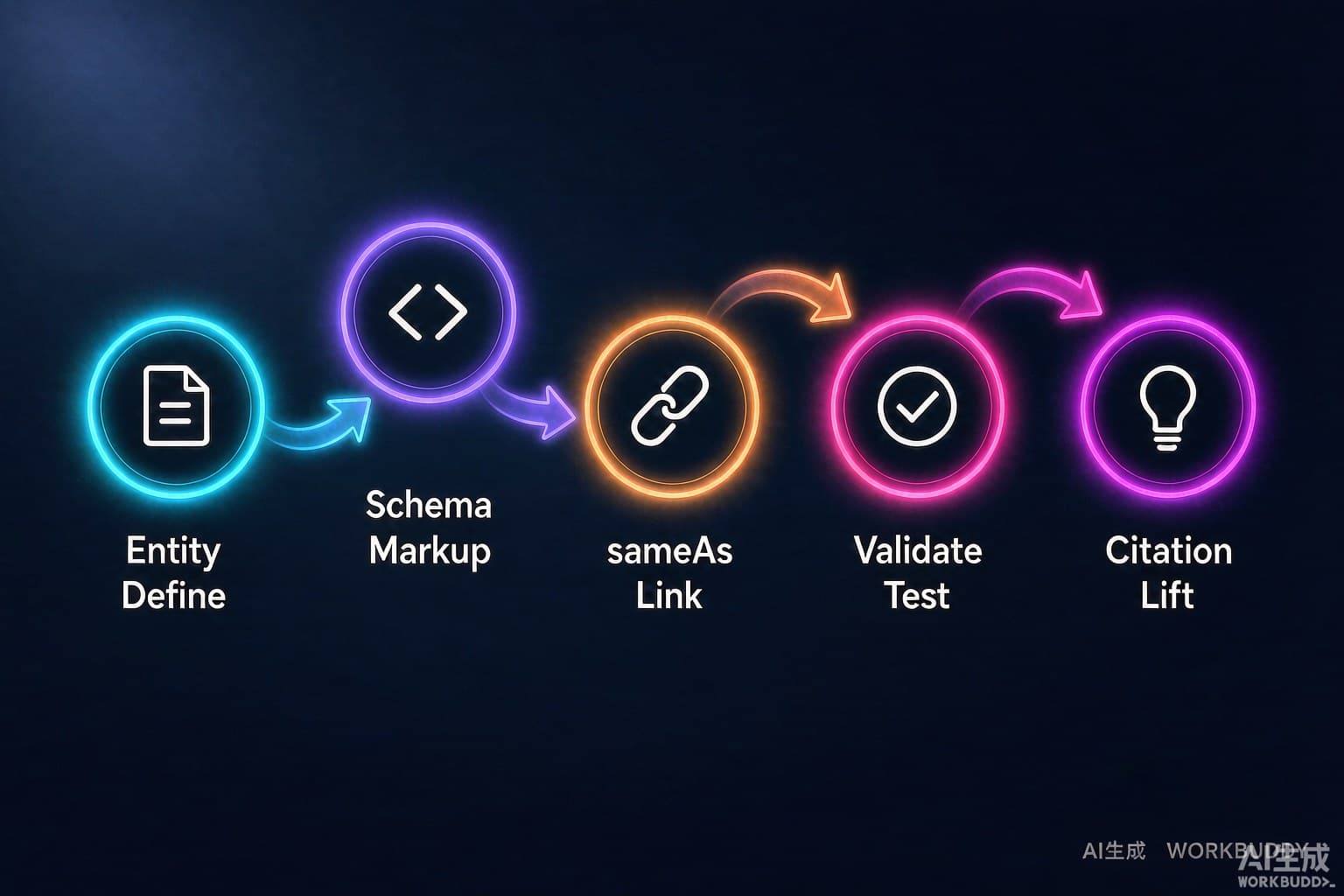
This article explores “Structured Data for GEO: How Schema Markup Boosts AI Citation Rates” through GEO Optimization, GEO, SEO, and AI search visibility so readers can quickly assess whether the approach fits their business context.
Structured data is the most easily overlooked and most commonly misdone element of GEO. Many companies treat Schema markup as compliance code for search engines, throwing on a few tags and calling it done. But in the AI search era, Schema's role has changed — it is the "machine-readable mirror" that AI uses to understand your page. When ChatGPT or Perplexity judges a page's topic, entity, and credibility, structured data is the clearest signal source. This guide covers markup selection, field configuration, entity association, and testing — a complete structured data GEO methodology with operationally validated standards at each step.
Why Schema Matters More for GEO Than Traditional SEO
In the traditional SEO era, Schema markup's primary value was earning rich snippets in search results — star ratings, breadcrumb navigation. Useful, but not core — search engines primarily understood content through page text and links, with Schema as an auxiliary.
In GEO, Schema's role has been elevated. When LLMs judge whether a page is worth citing, they reference three signal layers: page text content (extractability), external authority sources (credibility), and structured data (entity clarity). Schema provides the most precise entity information — it explicitly tells AI what entity a page describes, what properties that entity has, and how entities relate. Where natural language text may be ambiguous, structured data removes ambiguity.
After auditing 100+ enterprise websites, we found about 70% have Schema issues that impact GEO effectiveness: markup type mismatching page content, missing critical fields, markup content not matching visible content, and missing entity associations. The direct consequence is AI misjudging page entities, leading to non-citation or inaccurate descriptions when answering relevant queries.
Six Highest-Priority Schema Types for GEO
Not all Schema types have equal GEO value. These six have been validated as most effective for boosting AI citation rates in our projects.
Type 1: Organization. This is the foundation of brand entity recognition. When AI answers questions like "what does XX company do," it looks for Organization markup first. Required fields: name, url, logo, description, sameAs, foundingDate, contactPoint. The description field is the most easily extracted brand definition — write it accurately with core business keywords. We recommend 50 to 80 words, formatted as "brand name + core business + target market + key advantage." For example: "XX is an AI search visibility service provider specializing in cross-border e-commerce GEO optimization, serving Chinese overseas brands, with core strengths in AI citation monitoring and structured content transformation."
Type 2: FAQPage. The highest-ROI markup type in GEO. FAQPage lets AI directly extract Q&A pairs from your page for answer-type queries. Key requirement: every question and answer field in Schema must exactly match the visible FAQ content on the page. The most common high-frequency error we see is frontend displaying one set of FAQs while Schema contains a different set — this inconsistency makes AI reduce the page's overall trust score. The correct approach: read Schema data directly from frontend data, no manual maintenance. Each answer should be 120 to 250 words, following a "conclusion → conditions → data" structure.
Type 3: Article. Blog article pages must have this markup. Key fields: headline (matching page H1), description (matching meta description), datePublished, dateModified, author, image, articleBody (about 200 words). datePublished and dateModified must reflect actual dates — do not adjust them for SEO effect. AI references time information to judge content freshness — if an article marked as published in 2024 has actually outdated content, AI lowers its citation priority. We recommend reviewing article time markers quarterly to ensure modified articles update dateModified.
Type 4: Product. Product page structured data directly affects AI's description accuracy when recommending products. Key fields: name, description, brand, category, offers (price and availability), aggregateRating. The description field should not use marketing copy — use factual descriptions including core parameters, suitable scenarios, and certification info. A Schema description reading "disruptive innovation, ultimate experience" gives AI almost nothing to extract. But "316 stainless steel insulated tumbler, 500ml capacity, 12-hour insulation, FDA and CE certified, suitable for outdoor and office scenarios" gives AI everything it needs.
Type 5: BreadcrumbList. Breadcrumb navigation markup helps AI understand page hierarchy and attribution. When a product belongs to a category, and a category belongs to a scenario, BreadcrumbList shows AI where the product sits in the content system. This helps AI answer "what products are in category XX" or "what products suit scenario XX." Ensure each level's name property contains keywords, like "Home > Cross-Border E-Commerce > GEO Services > Competitor Monitoring."
Type 6: Review and AggregateRating. If your product or service has user reviews, marking up review data lets AI cite specific ratings and review counts in recommendations. AggregateRating must correspond to visible rating components on the page, and rating values and counts must be real. In our tests, product pages with AggregateRating markup scoring 4.0+ were cited as recommended options about 35% more often than unmarked pages.
sameAs: The Core Tool for Brand Entity Association
sameAs is a frequently overlooked Organization property with extremely high GEO value. It tells AI: "my brand entity also has corresponding pages on these external authority sources — they are the same entity." Through sameAs, AI can cross-verify your official site brand information with Wikipedia, LinkedIn, Crunchbase, and other platforms, building a more complete brand entity understanding.
In a SaaS brand project, adding just 3 sameAs links (Wikipedia, LinkedIn, Crunchbase) to the Organization markup increased the brand's ChatGPT mention rate by approximately 25% over 8 weeks. Effects are not immediate — typically 4 to 8 weeks are needed before AI reflects the change, because AI needs time to crawl and associate the external information.
Three principles for sameAs. First, only link high-authority sources — Wikipedia, LinkedIn company page, Crunchbase, GitHub (tech brands), industry association sites, G2 or Capterra (SaaS brands). Do not link to low-quality directory sites or bulk article sites — AI uses sameAs link quality to assess your brand authority. Second, ensure brand names and descriptions on sameAs-linked pages match your official site — inconsistencies cause AI to reduce trust. Third, keep sameAs links to 3 to 8 — too many looks suspicious.
Common Schema Errors and Fixes
Here are the high-frequency errors we found auditing 100+ enterprise websites, with corresponding fixes.
Error 1: Markup type mismatching page content. The classic example: marking a homepage as Product (because it showcases products) or a product page as Article. Fix: each page type gets a fixed markup type — homepage and about page get Organization, blog articles get Article, product pages get Product, FAQ pages get FAQPage, service pages get Service. Do not stack unrelated markup types on a single page.
Error 2: Missing critical fields. Organization missing sameAs and description, Article missing datePublished and author, Product missing brand and offers. Fix: refer to schema.org type documentation and ensure each markup includes at minimum the required and recommended fields. Maintain a field checklist for each markup type and verify after every update.
Error 3: Markup content not matching visible content. Page H1 says "Cross-Border GEO Service" but Article headline markup says "GEO Optimization Solution"; page shows 5 FAQ items but FAQPage markup only has 3. Fix: build automated workflows where Schema data reads directly from CMS or frontend data, not manually maintained duplicates. For static pages, update Schema markup whenever content changes.
Error 4: Marketing fluff in description fields. description reads "disruptive innovation, ultimate experience, industry leader" — these give AI almost nothing. Fix: rewrite all description fields as factual descriptions with specific parameters, use cases, and verifiable information. Reference format: "brand name + core business + target market + key advantage/parameters."
Error 5: No site-wide Schema coverage. Only the homepage has Organization markup, other pages have nothing. Fix: at minimum, mark every page type with its corresponding Schema — all blog articles get Article, all product pages get Product, all FAQ pages get FAQPage, all pages get BreadcrumbList. Site-wide coverage is GEO's baseline requirement.
Validation and Testing Workflow
Writing Schema is not the end — you must validate. Here is the standardized validation workflow after every Schema update.
Step 1: Test each page with Google Rich Results Test (search for "Google Rich Results Test"). Enter the URL and the tool returns all detected markup types, field completeness, and error warnings. Ensure zero errors and zero warnings — warnings may not trigger search engine penalties but can affect AI's trust in the markup information.
Step 2: Validate markup compliance and field type correctness with the Schema.org validator. This tool checks whether your markup follows schema.org specifications, including correct field types (e.g., datePublished must be ISO 8601 format) and required field completeness.
Step 3: Manual spot-check for content consistency. Randomly select 5 pages with Schema markup and manually compare markup content with visible page content, ensuring exact match. Focus on: Organization description matching homepage brand description, FAQPage questions and answers matching frontend, Article datePublished reflecting real publication date.
Step 4: AI citation testing. 4 to 8 weeks after Schema updates, test with 20 to 50 target questions on ChatGPT and Perplexity, observing whether AI responses mention your brand, whether descriptions are more accurate, and whether your marked FAQ content is cited. If citation rates do not improve, the issue is usually insufficient content coverage or weak external signals — these need to be addressed alongside content and authority signal strategies.
Coordinating Structured Data with Content Strategy
Structured data is not an isolated engineering task — it must coordinate with content strategy to maximize effectiveness. Good content gives Schema something to mark; good Schema helps AI better understand and cite content.
We recommend maintaining a "Schema-to-content mapping table" listing each markup type's corresponding page type, required fields, content source, and owner. This table ensures Schema updates when content changes and content follows up when Schema changes. In a B2B overseas brand project, establishing this mapping table and enforcing the maintenance process boosted the brand's AI description accuracy from 35% to 72% within 3 months.
Finally, structured data is a necessary but not sufficient condition for GEO. Perfect Schema markup alone will not make AI cite your content — it needs to work alongside high-quality content, stable external authority signals, and consistent brand entity information. But if Schema is done wrong, even good content and signals will cause AI to misjudge your page. Treat structured data as a "machine-readable mirror" to maintain — markup what the page has; do not add in Schema what the page does not have. This is the core principle of GEO structured data work.
Prefer to hand this to a specialist team? Learn more about our professional GEO agency.