
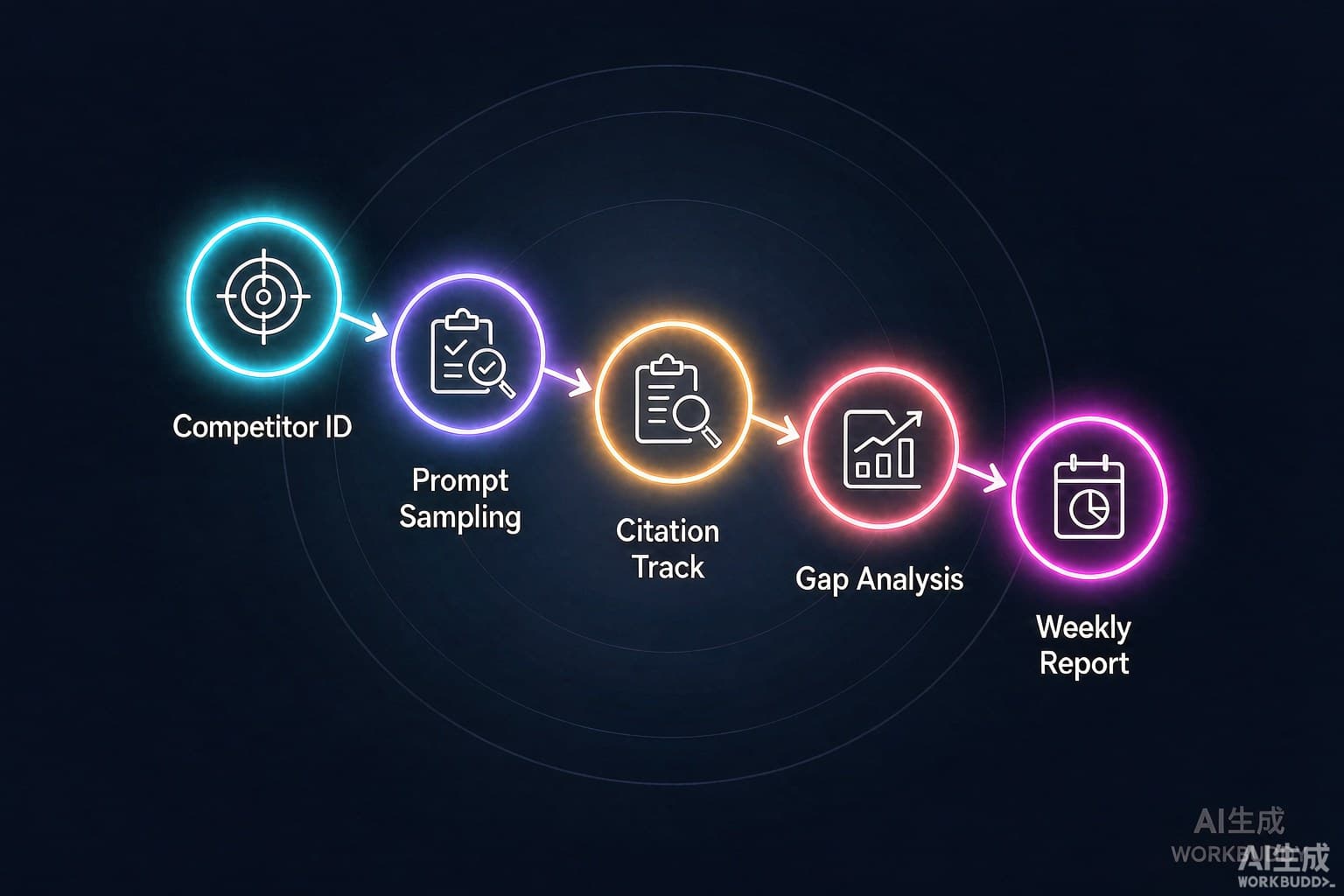
This article explores “GEO Competitor Monitoring: How to Track Rivals in AI Search” through GEO Optimization, GEO, SEO, and AI search visibility so readers can quickly assess whether the approach fits their business context.
In the AI search era, your competitors may be getting recommended by ChatGPT, Perplexity, and Gemini to your potential customers — and you have no idea. Traditional competitor analysis tools like SimilarWeb, Ahrefs, and Semrush can tell you about search traffic and backlinks, but they cannot answer a far more critical question: when users ask AI about your industry, are competitors mentioned, is the description accurate, and where do they rank in the recommendation? This information gap is quietly costing overseas brands high-quality decision-stage traffic. This guide breaks down an actionable GEO competitor monitoring framework covering four core dimensions, three intelligence sources, and a weekly tracking workflow.
Why Traditional Competitor Monitoring Falls Short
Traditional competitor monitoring tracks search rankings and traffic. But in AI search, users no longer type keywords and click links — they ask natural-language questions and receive synthesized answers. This means competitor visibility is no longer about ranking position but about whether they are mentioned in AI responses, how they are described, and where they appear in the recommendation. Traditional tools cannot see this layer.
While working with an overseas SaaS brand, we found it consistently ranked in the top three for its brand keyword on Google. But when ChatGPT answered relevant industry questions, this brand was completely absent — while two competitors with far lower search rankings were frequently recommended. The reason: those competitors had extensive deep-dive discussion threads in technical communities, while this brand had almost no community presence. If you only look at traditional monitoring data, this brand would falsely conclude it was winning.
Four Monitoring Dimensions
GEO competitor monitoring covers four dimensions, each answering a different question.
Dimension 1: Mention Rate. How frequently competitors are mentioned across your question library. This is the most basic metric — it answers "do they show up at all." We recommend maintaining a library of 50 to 100 core industry questions, testing weekly on at least two AI platforms, and recording each competitor's mention count. Mention rate = questions where mentioned / total questions. In our case database, industry-leading brands typically see 30% to 60%, mid-size brands 5% to 15%, and over 40% of brands have zero mentions.
Dimension 2: Citation Accuracy. When competitors are mentioned, whether AI correctly describes their business scope, product features, pricing position, and target market. This answers "is the mention correct." After tracking 40+ brands, we found only about 35% of mentions are fully accurate, about 40% have information bias or outdated details, and the remaining 25% contain serious errors. Low accuracy is not necessarily bad news — if a competitor is frequently mentioned but incorrectly described, it means AI's understanding is confused, and you have an opportunity to capture citations by providing more accurate, structured content.
Dimension 3: Recommendation Position. When AI recommends multiple brands, where does the competitor rank. This answers "how good is the visibility." Brands recommended in the top three capture far more mindshare than those appearing later. Through A/B testing, we found brands recommended in the top three see an average 2.3x greater increase in branded search volume within two weeks compared to those in fourth place or below. Position trends matter more than absolute position — if a competitor is gradually sliding from third to fifth, their content signals are decaying.
Dimension 4: Competitor Co-occurrence. When AI mentions both you and a competitor, what comparison framework does it use — price, features, use case, or target customer. This answers "how does AI see your relationship with competitors." If AI consistently compares you with competitors on price while your real strength is technical depth, your technical signals are too weak, and you need to strengthen technical parameters, certifications, and case studies.
Three Intelligence Sources
To gather data across these four dimensions, you need three channels.
Source 1: Direct AI Platform Queries. The most core and direct source. Run your question library on ChatGPT, Perplexity, Gemini, and Copilot, recording which brands appear in each answer, the description content, and recommendation order. Perplexity's advantage is that it annotates citation sources, letting you see exactly which pages AI referenced — providing clues about competitor content strategies. ChatGPT usually does not cite sources, but you can ask follow-up questions like "what information did you base this recommendation on" for hints. Aim for at least two platforms per week.
Source 2: Third-Party Signal Audit. AI considers signals beyond your website when recommending brands. Regularly audit competitor presence on third-party platforms: Wikipedia entry existence and quality, LinkedIn company page completeness, review count and rating on Trustpilot or G2, media coverage frequency, and community discussion depth on Reddit, Dev.to, and Hacker News. We recommend a quarterly competitor third-party signal audit, cross-referencing results with AI mention rates — strong third-party signals usually correlate with high AI mention rates. Exceptions (strong signals but low mentions) indicate the competitor's content is poorly structured, giving you an opportunity to leapfrog.
Source 3: Search Intent Evolution. User question patterns on AI platforms keep evolving, with new question scenarios emerging alongside industry events, product launches, and tech trends. Use Google Trends and AnswerThePublic to track question-variant growth for industry keywords, helping you spot new competitive scenarios early. For example, when a new industry standard emerges, questions about "XX standard compliance" surge — whoever gets cited first on these new questions captures mindshare. We helped an industrial export brand monitor a 4x increase in "XX certification" related questions over three months, proactively creating technical content that built citation advantages before competitors noticed.
Weekly Tracking Workflow
Turn monitoring into a repeatable process, not an occasional activity. Here is a proven weekly workflow.
Monday: Question Library Run. Execute 50 core questions on ChatGPT and Perplexity. Record: question number, platform, brands appearing (in order), description keywords per brand, and whether source links are cited. A full run takes about 2 to 3 hours and can be split between two people. If your library exceeds 100 questions, rotate A/B groups biweekly.
Tuesday: Data Entry and Diff. Enter results into the monitoring sheet and compare with last week's data, flagging three change types: new brands (who appeared for the first time), disappeared brands (who dropped out), and description changes (what wording shifted). Description changes are especially telling — if AI's description of a competitor shifts from "a leading XX service provider" to "a company offering XX services," that competitor's authority signals may be decaying.
Wednesday: Gap Analysis. Select 3 high-value questions where your brand was not mentioned but competitors were. Answer three sub-questions: why was the competitor cited (site content structure, third-party signals, community discussions), where is your gap (missing content, weak signals, or entity inconsistency), and what action can you take this week (add content, optimize Schema, participate in community discussions). Convert analysis conclusions into this week's content action items.
Thursday: Platform Cross-Reference. Select 10 core questions and run them across ChatGPT, Perplexity, Gemini, and Copilot. Record which brands show significant performance differences across platforms and analyze why. For example, if a competitor is cited on Perplexity but not ChatGPT, their site may be well-structured but they lack third-party community signals. Platform analysis helps you optimize resource allocation — if your target customers primarily use Perplexity, focus optimization effort on site structure.
Friday: Action Item Execution. Convert this week's analysis conclusions into concrete actions. Common items include: adding FAQ pages, optimizing product pages with parameter-plus-judgment format, answering real user questions in communities, updating brand information on third-party platforms, and creating topic pages for high-value questions. Each action item should have an expected outcome and verification timeline — typically 4 to 8 weeks before changes appear in AI responses.
Principles for Interpreting Competitor Intelligence
Collecting data is only step one; interpreting it correctly is what matters. Three principles to keep in mind.
Principle 1: Do not chase full coverage. You do not need to be mentioned on every question. Prioritize those most relevant to your core business with the highest commercial value. Leading on 10 high-value questions is more meaningful than covering 100 low-value ones. We recommend tiering your question library into A (core conversion questions), B (scenario coverage), and C (long-tail coverage) — A-tier mention rate is your core KPI.
Principle 2: Watch trends, not absolute values. Single-query results have randomness — AI may answer the same question differently across sessions. But if you record data for 4+ consecutive weeks, trends emerge. The standard: directional changes sustained for 3+ weeks are real trends; single-week fluctuations should not trigger action.
Principle 3: Competitor mentions do not mean you lost. If a competitor is mentioned but inaccurately described, or appears in answers to low-value questions, it is not necessarily a threat. What should worry you: a competitor accurately described and ranked in the top three on your core A-tier questions, with a stable or rising trend. That requires immediate response.
From Monitoring to Action: Closing the Loop
The ultimate purpose of monitoring is to guide action. At the end of each monitoring cycle, produce an action brief containing: this week's mention rate change on A-tier questions, competitor performance trends on your core questions, 2 to 3 actionable gaps identified, and corresponding action items with owners. This brief does not need to be long — one page is enough — but it transforms monitoring from "collecting data" to "driving decisions."
The value of GEO competitor monitoring is not in seeing what competitors do, but in removing blind spots about what you should do. When your content strategy is data-driven rather than guesswork, every article, every community participation, and every Schema optimization has a clear purpose — claiming your position in AI search competition.
Prefer to hand this to a specialist team? Learn more about our overseas GEO service.