
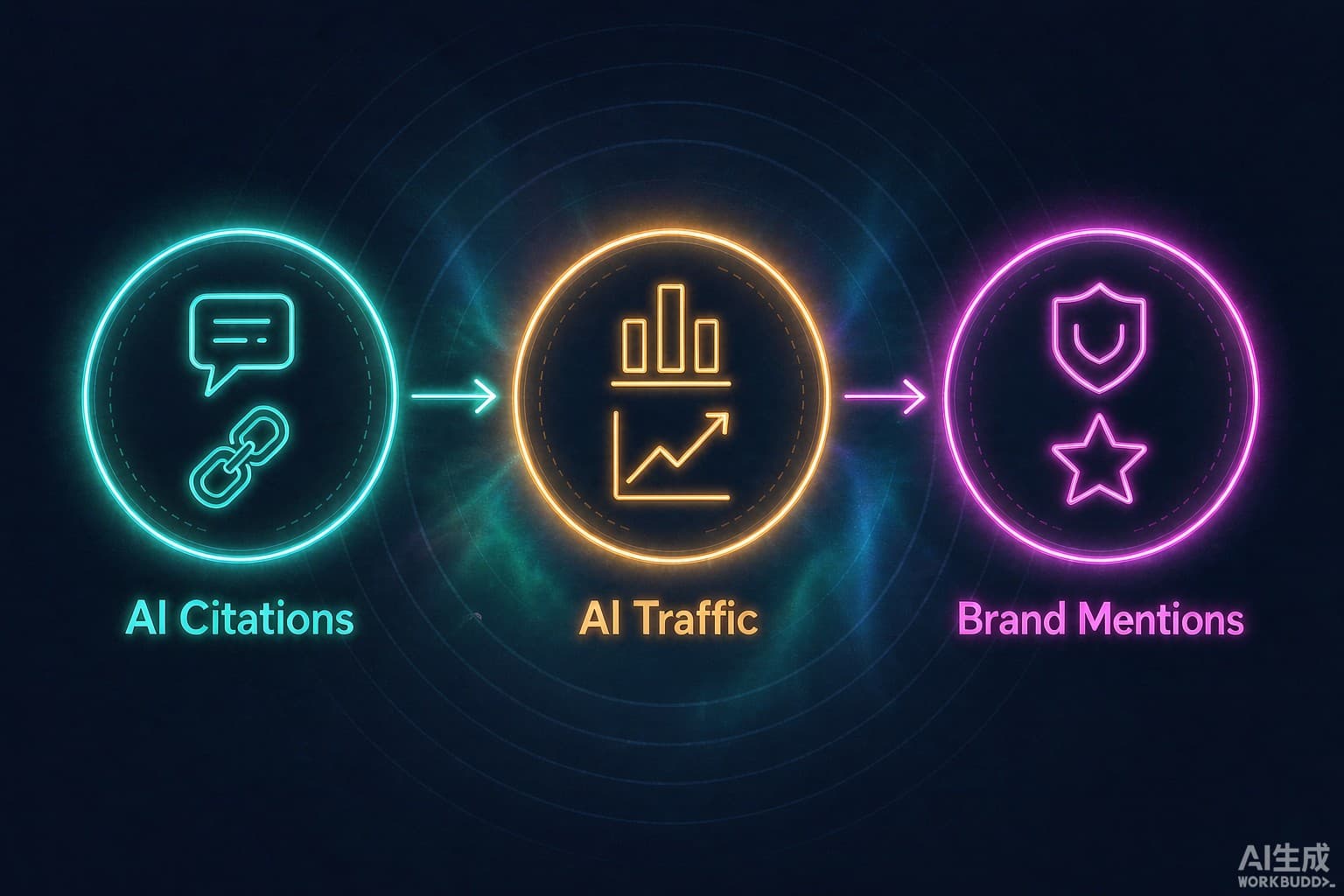
This article explores “How to Measure GEO Results: The Three Ledgers of AI Citations, AI Traffic, and Brand Mentions” through GEO Optimization, GEO, SEO, and AI search visibility so readers can quickly assess whether the approach fits their business context.
Bottom line first: do not measure GEO with rankings. Measure it with three ledgers — AI citations tell you whether you get mentioned, AI traffic tells you whether anyone clicks through, and brand mentions tell you what the AI actually says about you. When all three move, GEO is working. When only one moves, it is usually a mirage.
Why rankings stopped working: the AI engines themselves are unstable. Ask ChatGPT the same question twice on the same day and the cited sites can differ. A ranking is a volatile snapshot. Use it as a KPI and your team ends up chasing noise. Each of the three ledgers, on the other hand, reduces to a number you can actually report.
Ledger 1: AI citations
Definition: the number of times your domain, brand name, or pages appear in answers across ChatGPT, Perplexity, Gemini, and AI Overviews.
How to measure: fix a set of 20 to 50 questions your real customers ask (not questions you invented), run the same set weekly against the same models with the same phrasing, and record three states per question — cited / mentioned without link / absent. Where the question list should come from is covered in finding keywords inside customer questions.
Three metrics:
1. Citation rate: cited questions divided by total questions. In the cold-start phase, 10% to 20% is a pass; after three months you should be above 30%.
2. Competitor gap: your citation rate minus the top competitor's. This number matters more than the absolute value — it decides whether the customer's AI shows you or them. The how-to lives in the competitor monitoring guide.
3. Content hit distribution: which pages get cited. If citations concentrate on two or three posts while dozens sit at zero, your content architecture is the problem. Fix the pillar-cluster structure instead of publishing more.
Measurement discipline matters: fixed questions, fixed model versions, fixed phrasing. Change the phrasing and the answer changes — that is not a performance change.
Ledger 2: AI traffic
Definition: sessions landing on your site from AI platforms. In GA4 these hide mostly under the Referral channel, with sources like chatgpt.com, perplexity.ai, gemini.google.com, and copilot.microsoft.com.
How to measure: filter session source in the Traffic acquisition report with a regex over those domains. The exact steps and the attribution traps are in the companion piece on identifying AI traffic in GA4. The short version:
1. Keep expectations on volume low. AI traffic today is typically a fraction of organic search. A few hundred to a few thousand sessions per month on a mid-size site is normal.
2. Judge quality, not quantity. Users arriving from ChatGPT carry full context — the AI already filtered for them — so conversion rates and engagement often beat plain organic search. Build an AI channel segment in GA4 and compare conversion rates.
3. Watch the slope. Week-over-week and month-over-month trends matter far more than any single week's absolute number.
Ledger 3: brand mentions
Definition: when the AI mentions you, what it says. Are you listed as a recommendation, used as a price-comparison foil, or does it misspell your name?
This ledger is the most neglected and the most revenue-relevant. When a buyer asks ChatGPT for vendor recommendations, the AI's exact wording becomes your sales script. If it frames you as "a budget-friendly option," moving upmarket afterwards gets much harder.
How to measure: with the same fixed question list, archive the exact sentences about you each run and diff them monthly. Watch three things:
1. Position in the recommendation order. Whoever the AI lists first gets clicked.
2. The labels attached to you. "Cost-effective" versus "technical leader" versus "niche" directly shapes buyer expectations.
3. Whether facts are stale. AI citing your old pricing or a discontinued product line is common. When you spot it, locate the source page and fix the content — that works better than complaining to the platform.
To systematically improve how you get mentioned, start with the content rewriting step in the 5-step GEO guide.
Reading the three ledgers together
Any single ledger misleads. Combinations are the health check:
Citations up, traffic flat: links are missing or buried in link-free text answers. Check link clarity and placement in your content.
Traffic up, citations flat: probably a temporary spike on the AI platform, or momentum from another channel. Go back to content fundamentals.
Mentions growing but labels wrong: fact correction is lagging — the AI is still quoting old information.
All three flat: check the foundation first — can AI crawlers reach you at all (covered in the AI crawler trade-off), and is structured data being emitted (see the Schema markup guide).
Reporting cadence
Report monthly: one trend chart per ledger, plus a list of pages newly cited this month. For leadership, citation-rate movement and AI traffic conversion numbers are the two most persuasive figures. If you would rather hand this monitoring to a specialized team, the vetting criteria are in how to choose a GEO agency.
One last reminder: GEO ledgers only mean something when recorded continuously. A single screenshot proves nothing. Eight straight weeks of curves tell you which content the AI is slowly memorizing.