
This article explores “Should You Block GPTBot? The AI Crawler, robots.txt, and llms.txt Trade-Off” through GEO Optimization, GEO, SEO, and AI search visibility so readers can quickly assess whether the approach fits their business context.
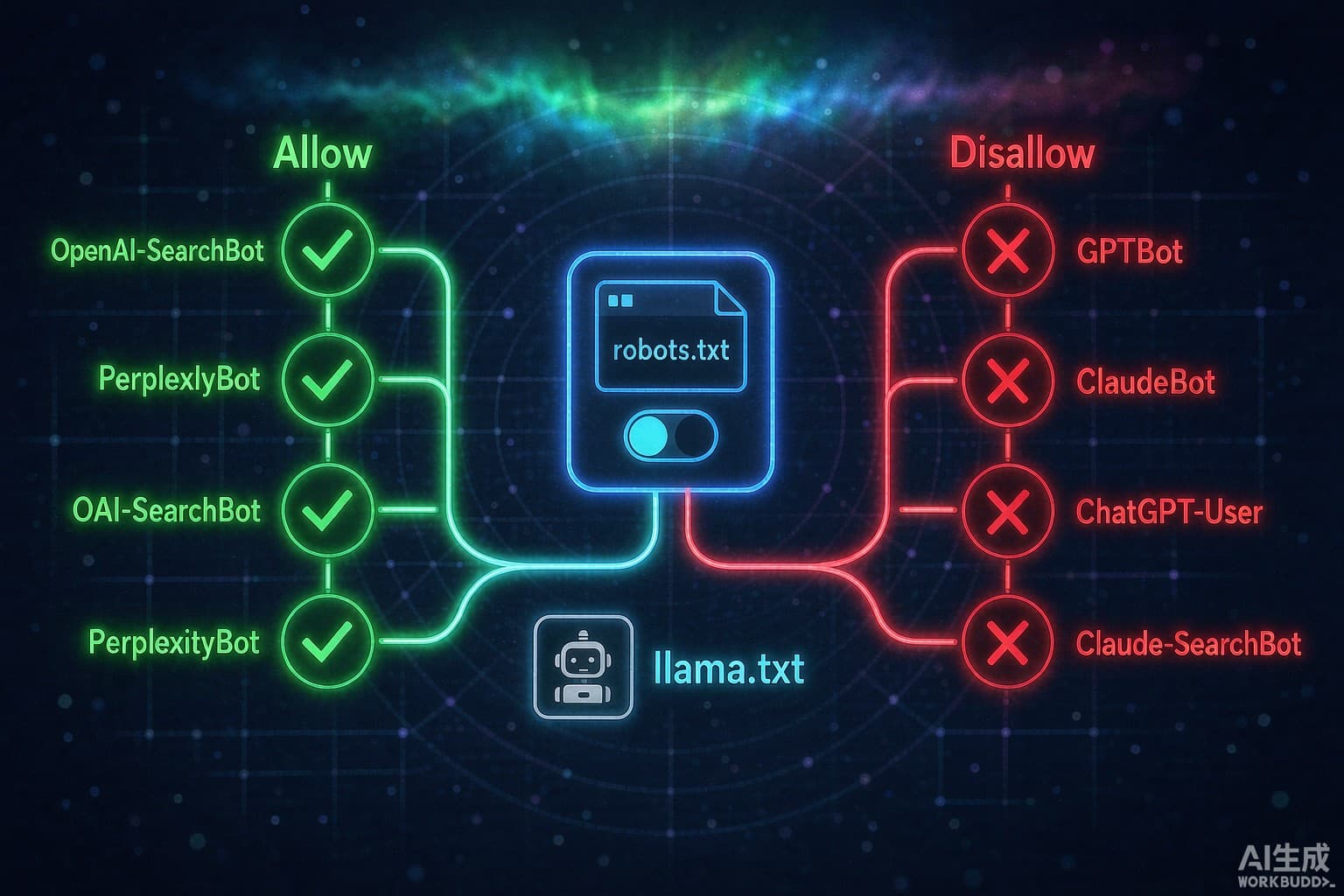
Bottom line first: if you want GEO results, allow the AI search crawlers by default — OAI-SearchBot, PerplexityBot, ChatGPT-User. The training crawlers (GPTBot, ClaudeBot, Google-Extended) are also fine to allow; block them only if your content is a core paid asset. Create llms.txt if you like — it is cheap — but do not treat it as a switch.
The common mistake is executing "block the AI bots" as a slogan. In robots.txt, writing User-agent: GPTBot and User-agent: OAI-SearchBot have entirely different consequences — the former stops your content from training models, the latter stops ChatGPT's live search from reading your pages at all. Block everything and you pave over the road to your own store, then complain about foot traffic.
First, split crawlers into two classes
Class one: search and browsing crawlers, which directly determine whether you get cited.
1. OAI-SearchBot: OpenAI's search crawler feeding ChatGPT's web search. Block it and ChatGPT can hardly cite you in search mode.
2. ChatGPT-User: fires when a user asks ChatGPT to open your page. Block it and the AI literally cannot look even when asked.
3. PerplexityBot: Perplexity's indexing crawler. Want Perplexity citations? Keep it open.
Class two: training crawlers, which affect whether you exist in the model's knowledge, not any single answer.
1. GPTBot: OpenAI training.
2. ClaudeBot / anthropic-ai: Anthropic training.
3. Google-Extended: Google's Gemini training.
Note that Google-Extended and Googlebot are different agents. Googlebot powers the search index, and AI Overviews is built on that search index. Blocking Google-Extended affects Gemini training only, not AI Overviews. Accidentally blocking Googlebot takes Google Search down with it — that is an incident, not a policy.
The decision is three questions
1. Does your business model eat "being mentioned by AI"? Export brands, B2B lead gen, DTC sites — yes, allow all search crawlers. Paywalled content or membership communities are the only models that need to think twice.
2. Do you mind your content training models? Most marketing content loses nothing real from being trained on; allowing GPTBot buys long-term brand presence inside the models. Core technical docs and proprietary research can be blocked at the directory level.
3. Can your servers take the crawling? AI crawler volume today is far below Googlebot's. If you survive Google, you survive them. Under real pressure, use Crawl-delay or rate controls — not a ban.
A robots.txt you can copy
Most export-brand sites can ship this as-is:
User-agent: *
Allow: /
User-agent: GPTBot
Allow: /
User-agent: OAI-SearchBot
Allow: /
User-agent: PerplexityBot
Allow: /
To protect sensitive sections, add targeted rules like Disallow: /internal-docs/. And after deploying, actually verify: check the robots reporting in Google Search Console and re-confirm UA names against OpenAI's published documentation every few months — the crawler roster keeps evolving, and a 2025 config is not a permanent answer.
llms.txt: make one, but do not deify it
llms.txt is a 2024 proposal: a Markdown file at your root describing your site to large models — who you are, where the core pages live, the key facts.
The honest status: it is not an official standard, and no major AI platform has committed to fetching it. Treat it as a low-cost readability supplement, not an "create it and the AI remembers you" switch. The real levers are still these three:
1. Pages that parse cleanly: proper heading hierarchy, server-rendered HTML instead of client-only rendering.
2. Structured data in place: FAQ, Article, Organization schema output — the how-to is in the Schema markup guide.
3. Updates get noticed fast: ChatGPT search leans heavily on the Bing index, and IndexNow gets Bing to recrawl new content sooner — which shortens the lag from publishing to being citable in ChatGPT.
Writing llms.txt before doing these three is polishing the sign while the shelves sit empty.
Verify the crawlers actually came
Grep your server logs for these UA strings: GPTBot, OAI-SearchBot, PerplexityBot, ClaudeBot, Google-Extended. Crawl entries mean your allow rules took effect. Cross-reference with the AI channel in GA4 (how to build it is in the AI traffic attribution walkthrough) — when both ends line up, the pipeline is live.
If AI crawlers never appear in logs, first rule out robots.txt mistakes, then check whether your CDN or firewall is intercepting unknown UAs as hostile traffic — many default bot-protection rules block GPTBot. That is the invisible culprit behind a zero-citation quarter.
Allowing crawlers is just the foundation. For what to write so the AI actually cites you, return to the 5-step GEO method; for how the whole system fits together, see the GEO service program. Get the foundation right, and every step after it stops being wasted.